

The real question is who made the decisions
A few months ago, someone looked at my design work and said: “I can tell you used AI to make this.” But I hadn’t. I had built the composition myself, chosen every element and discarded around forty directions along the way.
Later, I created another version using AI-generated flowers, textures and paper fragments. I cut them apart in Figma, recoloured them and rebuilt the composition by hand. It used significantly more AI, yet people said it felt more human.
The project was for Summer of Pride Kiki, connected to Utrecht’s ballroom community. Ballroom is not simply an aesthetic to borrow from; it carries its own history, codes and cultural context. This edition touched on trans identity, and the obvious visual route would have been a solemn, memorial one. It could have looked beautiful, but it would have been wrong. People were coming together to dance, so the work needed joy, abundance, softness and celebration.
This contradiction revealed something important: the use of AI tells us little about authorship. A human can make generic work, while a designer using AI can still direct every important choice.
The better question is not: Did AI make this? It is: who made the decisions?
Who understood the context? Who knew what to keep, what to reject, and why? Those questions point to the part of design that happens before the final artefact and lives in judgement.
What is the taste gap?
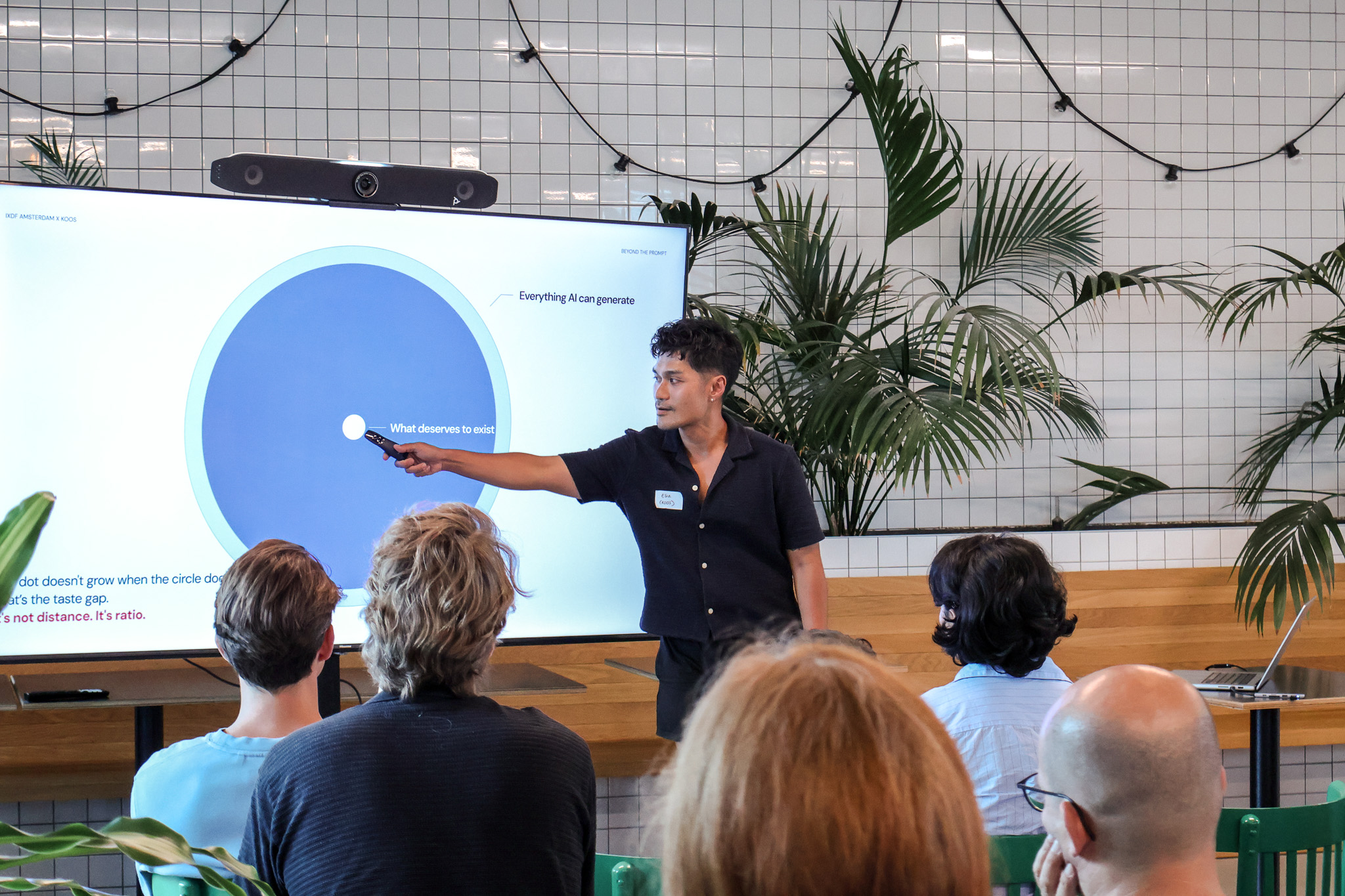
I see the taste gap as the difference between everything AI can generate and what should be created for a particular brief, audience and moment.
Imagine a circle containing every interface, image, campaign and variation AI can produce. That circle keeps expanding. Somewhere inside it is a dot: the idea that is right for this context. The circle grows, but the dot does not.
The challenge is not that AI creates obviously bad work. It is that it can create a hundred convincing options that all look equally resolved. This creates premature resolution: polished output encourages us to treat an idea as right before we have critically questioned it.

Taste can sound like aesthetic preference, liking minimalism, a typeface or a visual style, but professional design judgement is more rigorous. It combines research, craft, cultural understanding, strategy and human behaviour to explain why a decision is appropriate for a particular audience and situation.
Taste is not: “I prefer this onboarding flow.” It is: “This flow is efficient, but it asks users to share personal information before we have given them a reason to trust us.”
It helps us recognise when something is beautiful but wrong, efficient but overwhelming, or exactly what a stakeholder requested but not what users need.
Taste is not preference. It's judgement with evidence.
What AI is actually changing in product design
AI is compressing the middle of the design process. Synthesis, documentation, interface variations, first drafts and prototypes can all be produced faster. That speed is useful, but it shifts where designers create the most value.
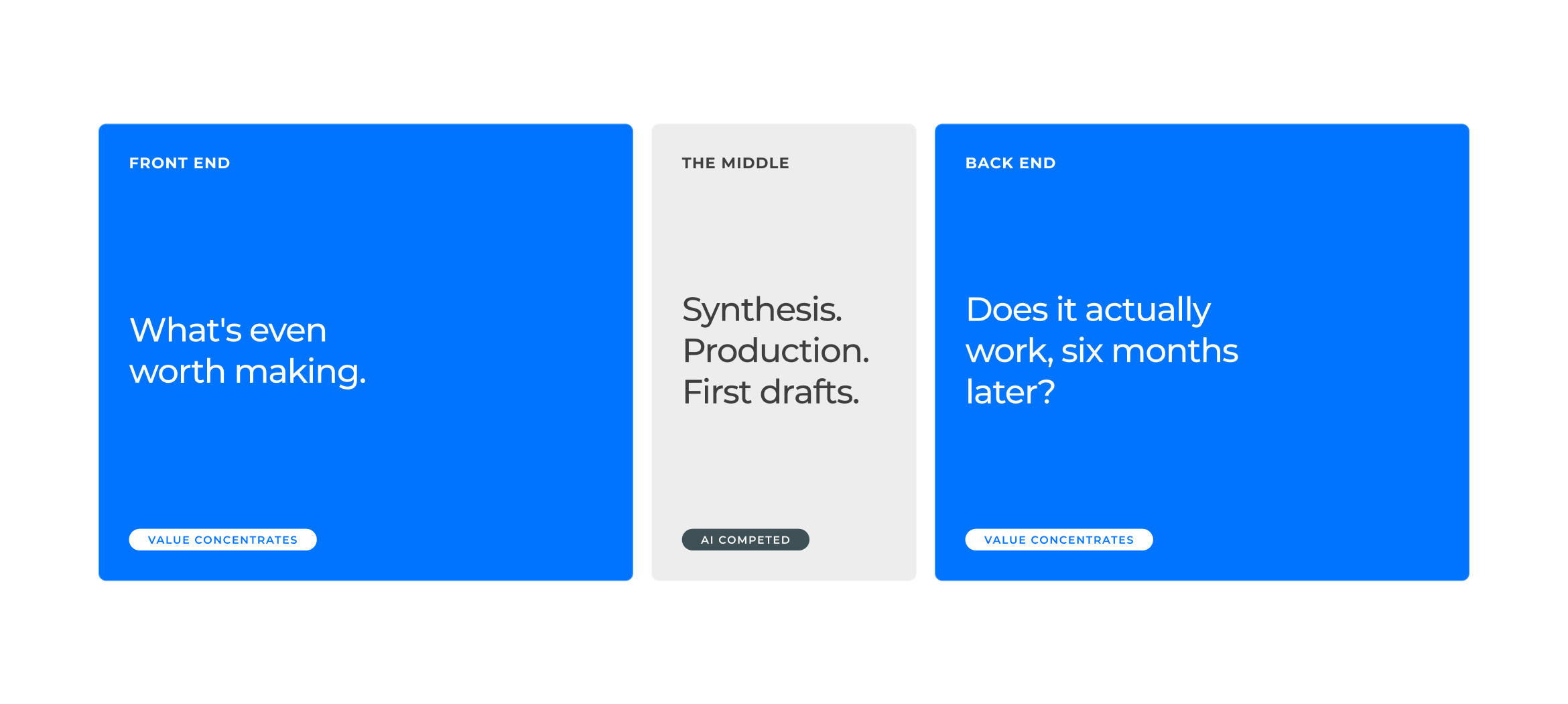
As production becomes cheaper, value concentrates at two ends:
- At the front: understanding what is worth making, uncovering the real problem behind the brief and recognising what nobody in the room is saying.
- At the back: determining whether the product actually works for people, creates meaning and continues to deliver value after launch.
Technical capability alone does not make an experience useful, trustworthy or desirable. Someone still has to design the human system around the technology.
AI is really good at showing us what could exist. We are still responsible for deciding what should.
Could is about possibility. Should requires context, ethics, culture, strategy and consequences. AI can shorten onboarding, personalise interactions and remove friction. Designers must still recognise when shorter becomes confusing, personal becomes intrusive or friction protects people.
AI can generate what looks finished. Designers still have to know whether it is alive.
There is another consequence. When designers use the same platforms, prompt models trained on overlapping patterns and reward familiar forms, convergence becomes easy. We can already see it across design portfolios: gradients land in similar places, type choices rhyme and interfaces seem to have attended the same school. Generic design can look completely competent while leaving nothing behind.
Why do we need human judgment in AI design?
Human judgement matters in AI design because generating a valid solution is not the same as deciding whether it is the right solution. Designers still need to interpret research, understand context, challenge assumptions and judge which possibilities are appropriate for the people they are designing for.
At Koos, we notice four design moments that remain especially dependent on contact with reality:
- Being in the room
Research is more than a transcript. It includes the pause after someone says they are fine and the shift in energy when the right question is finally asked.
- Sensing what is not being said
People do not always articulate their needs directly. Designers notice hesitation, contradiction, workarounds and the issue nobody wants to put on a sticky note.
- Challenging the brief
AI works with the problem it is given. Designers sometimes create the most value by saying that the stated problem is too narrow or simply wrong – and by helping the team frame a better one.
- Bringing an independent perspective
Internal teams live inside their organisation’s assumptions. An outside designer can see patterns that have become invisible and ask difficult questions.
- Train your eye outside the screen
If every designer studies the same interfaces and prompts models trained on the same patterns, our work will converge. Look beyond design platforms: observe a market, a hardware store, rush-hour at a station or a community where you are the outsider. AI learns from existing patterns, but taste develops by noticing context and asking why.
What you risk when outsourcing the decision-making
AI does not need to force us into a choice to influence it. It only needs to make one option easier to accept. Think of a restaurant menu where one dish has a photograph: nobody forces you to order it, but the image gives it an advantage. AI-generated design can work the same way; the most resolved-looking direction becomes the easiest to choose.
The uncomfortable question is whether we selected an idea because it was right, or because it was the only one that already looked finished at 11 p.m.
Research into AI-assisted design has surfaced concerns about over-reliance, cognitive offloading and the erosion of foundational skills. That does not prove AI compromises judgement. It does mean designers should notice what they delegate to it: not only the work, but potentially the thinking behind it.
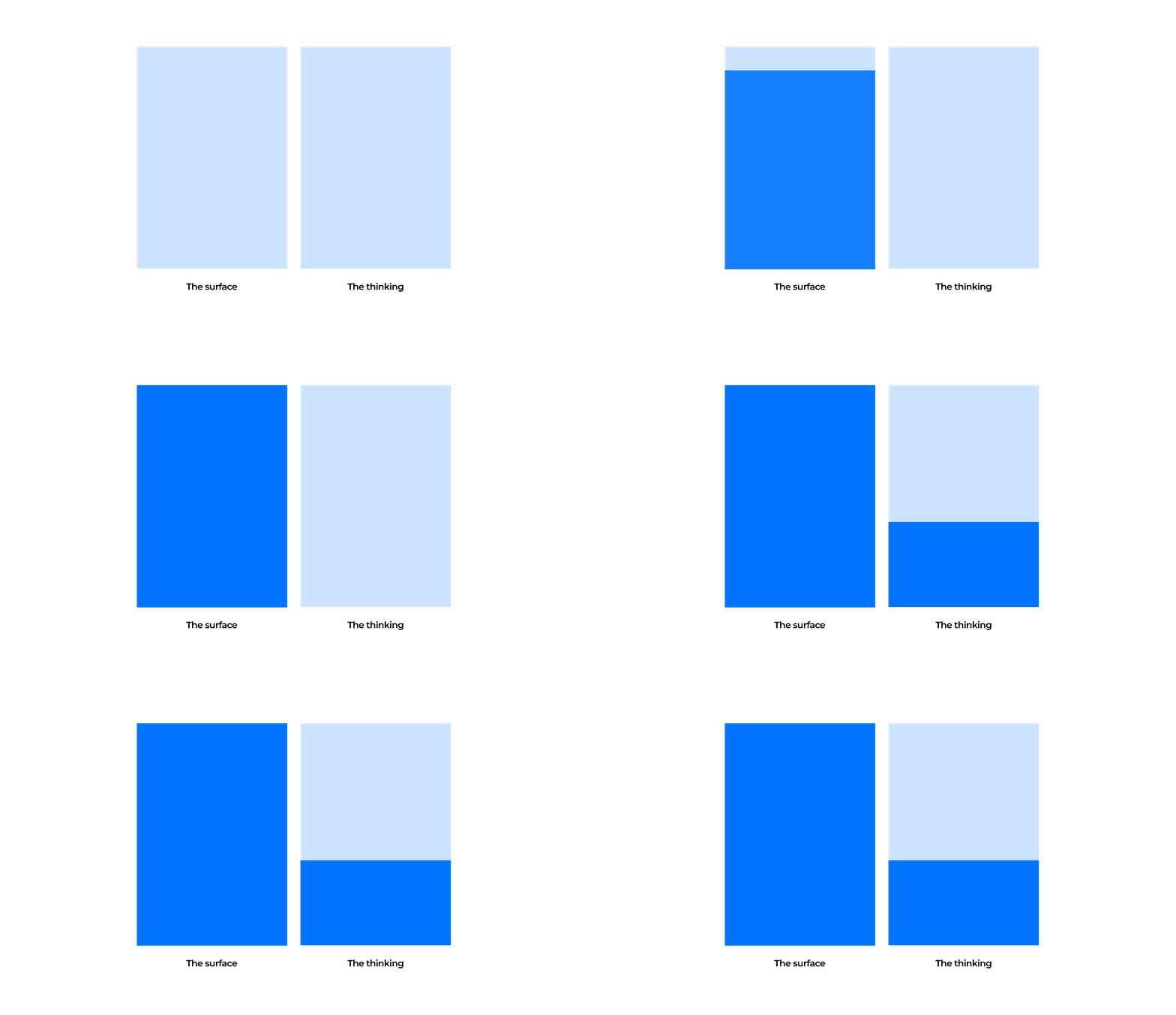
How to train your taste in an AI design process
Taste develops through exposure, comparison, failure, explanation and repetition. These five practices will help you protect and expand it.
- Write five sentences before you prompt
Before opening an AI tool, write down who the work is for, what you want to change, how the experience should and should not feel, and what could make a beautiful result wrong. Form a position before asking for polished outputs. AI should test your hypothesis, not become it.
- Apply the napkin test
Strip away the polish. If the idea appeared as a rough sketch on a napkin, would it still hold up? If it only works when beautifully rendered, it may be disguising a weak structure.
- Use AI as raw material, not a finished product
Treat AI output as material to dismantle, combine, reshape and reject. Rebuilding even one part forces you to make decisions again.
- Keep a rejection folder
Save one option you almost used and explain why you discarded it. A portfolio shows what survived. A rejection folder shows how you think.
- Train your eye outside the screen
If designers study the same interfaces and prompt models trained on the same patterns, our work will converge. Look beyond design platforms: observe markets, stations, unfamiliar signage and communities. AI learns from existing patterns, but taste develops by noticing context and asking why.
Making taste legible
Judgement is invisible. Stakeholders see the artefact, not the rejected options or the strategic problem that nearly disappeared beneath a pixel-perfect interface. When output is fast and furious, designers need to make their reasoning legible:
- Name the alternative and what its costs. Showing what another direction would communicate turns preference into a strategic choice.
- Locate the judgement in your audience. Instead of saying “I don’t like this,” explain how it will affect the people using it.
- Name what the work is not doing. Be willing to say: “This solves the visual problem, but not the strategic one.”
This shows that the work was directed, questioned and held to a standard beyond the first convincing output.
The question that remains
Replace everything under “The question that remains” with:
At the end of every product or service is a person trying to understand what to do, sharing something private or hoping not to make a mistake. They will never see the prompts or discarded options. They will only experience what survived.
Use AI ambitiously. Generate too much. Explore strange directions. But pause often enough to ask:
- What decision did I make here?
- What decision did the tool make easier?
- Am I keeping this because it is right?
- Or because it looks finished?
AI can generate a thousand possibilities. Someone still has to decide which ones deserve to become real and recognise when an answer is wrong, even when it looks right.
The future of design will not belong to people who avoid AI. It will belong to those who use it fluently without outsourcing their judgement.
Taste, at its deepest, is responsibility: a conviction about what should exist and the discipline to ask whether it deserves to. Closing the taste gap remains a human task.